




NEW ITEM
Keyword Part Number:
Keyword Part Number:
Sale: S$606.30
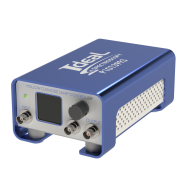
The Ideal Spectroscopy Pulsed Discharge Driver, model PDD-100, driver is a purpose-built instrument for generating reactive molecular species in pulsed supersonic expansion jets for downstream spectroscopic detection. This driver follows the same experimental approach used in our published laboratory work, see a sample list of publications below, where pulsed electric discharge jet methods were used to produce radicals and reactive intermediates for high-resolution laser-induced fluorescence studies.
In a typical experiment, a dilute precursor vapor is prepared using the low-temperature vapor pressure of an organic or organometallic liquid entrained in a high-pressure inert buffer gas, most commonly argon, with backing pressures typically in the range of 45 to 150 psi. When the pulsed valve opens, the gas mixture expands into vacuum, and at a precisely controlled delay an electrical discharge is initiated at the nozzle exit. The discharge fragments the precursor vapor into radicals, transient molecules, and reactive intermediates, which are then rapidly cooled during the supersonic expansion.
The driver accepts 18 to 36 VDC input power under typical experimental conditions and uses a TTL-compatible trigger input to define the exact firing time of the discharge pulse. The high-voltage output is provided on an SHV connector for connection through a vacuum feedthrough to the discharge jet electrode assembly. This arrangement gives the user precise timing control and reproducible discharge conditions, both of which are essential for producing stable radical signals in pulsed molecular beam experiments.
Our pulsed discharge jet assembly is built around a practical and proven geometry. Mounted in a Delrin cylinder are two ring-shaped electrodes separated by approximately 1 mm, with a central flow channel drilled through the middle of the assembly. This geometry allows the gas pulse to pass directly through the discharge region, promoting efficient fragmentation while preserving the rapid cooling needed for rotationally cold molecular beams.
In our experiments, the resulting supersonic expansion is typically crossed by a tunable laser beam approximately 2 to 3 cm downstream from the discharge source. The corresponding laser-induced fluorescence is collected with an optical collection assembly, passed through appropriate cut-off filters, and directed to the detector, typically a photomultiplier tube or CCD camera. By increasing the backing pressure and optimizing the timing and discharge conditions, very strong rotational cooling can be achieved, and in many cases rotational temperatures of only a few Kelvin are observed.
These products are intended for scientists and engineers who want a practical, research-proven way to quickly generate pulsed supersonic expansions and molecular beams containing reactive species. Rather than assembling a system from scratch, users can implement a design that follows directly from published work and has already been validated in laboratory spectroscopy experiments.
Spring 2026 product offerings from Ideal Spectroscopy are planned to include the Pulsed Discharge Jet Driver, Pulsed Discharge Jet Assemblies in both single and dual configurations, fluorescence light collection optical assemblies, and photomultiplier-based detector systems. Ideal Spectroscopy has also developed its own pulsed valves and pulsed valve drivers, which will be sold separately and will also be available as integrated components in our pulsed discharge jet assemblies.
The pulsed discharge jet methods used in these products follow the same experimental approach used in the published work of Tony C. Smith and Dennis J. Clouthier and co-workers, including:
We are passionate about spectroscopy and have developed these products to make it easier for scientists and engineers to quickly generate supersonic expansions and molecular beams containing these types of reactive species. Our hope is that these tools will help lower the barrier to entry for this kind of work and inspire renewed growth in research groups studying molecular and atomic spectroscopy.
At Ideal Spectroscopy, our goal is to provide practical, research-grade tools built by people who actively use and understand these methods, so that more laboratories can move quickly from setup to data collection and discovery.


Press ESC to Close

